 ">
">
The enterprise technology landscape is undergoing a fundamental shift, not driven by a single breakthrough, but by the convergence of two powerful forces, which are agentic AI and programmable networks.
For years, organizations have used automation to improve speed and efficiency, yet critical decision points still depended on human intervention. Approval loops, validation checks, and exception handling continued to slow execution. That operational ceiling is now beginning to lift.
Agentic AI introduces systems that can interpret context, make decisions, and act independently across connected environments. But intelligence without real-world control remains incomplete.
However, intelligence alone does not create enterprise value unless it can operate within real-world environments. For AI agents to manage infrastructure, respond to changing conditions, and coordinate across systems, they need programmable access to live network capabilities. This is where network APIs become foundational.
Network APIs do more than support agentic AI. They enable agents to interact with live network infrastructure, access real-time data, and trigger actions at scale. In other words, they are turning intelligent decisions into operational outcomes. Without this layer, agents remain powerful in theory but limited in practice.
Together, agentic AI and network APIs enable enterprises to move beyond task-based automation toward autonomous, scalable workflows that handle operational complexity in real time. The shift is already here. The question is how quickly businesses move from awareness to integration.
Table of Contents
Understanding agentic AI
What is agentic AI?
Agentic AI is an artificial intelligence system focused on a specific goal and capable of taking action autonomously. It is much more evolved and sophisticated than a chatbot, which simply generates responses.
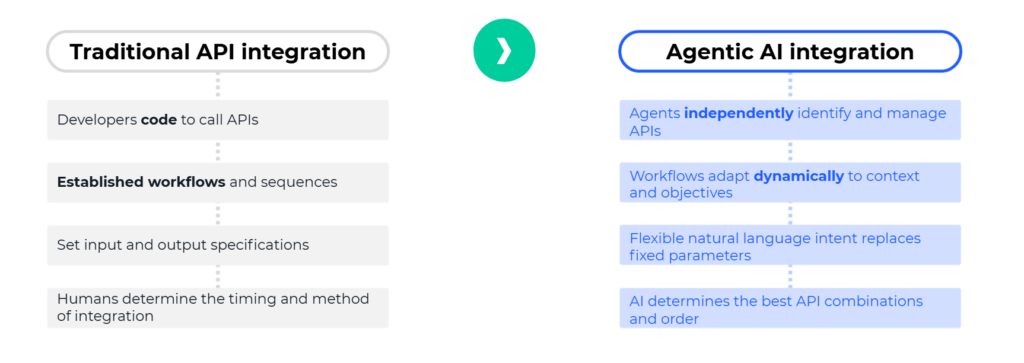
While a chatbot provides answers, AI-agentic systems take actions. You mustn’t mistake agentic AI for just ‘smarter’ AI. It behaves more like an operator than a tool. Shifting from established to dynamic workflows that can adapt independently to context and objectives!
Agentic AI vs generative AI
Generative AI creates content. It can be text, an image, a video, or code. It is certainly useful but fundamentally reactive. You need a prompt to get a response.
Agentic AI differs from generative AI in this regard, as it is proactive, operates continuously and independently, and can perform tasks and make decisions using various data sources and multiple tools. It is designed to execute a set of tasks within a workflow from end to end.
| Factor | Generative AI | Agentic AI |
| Functionality | Creates content | Executes tasks |
| Role | Assistant | Operator |
| Output | Text, media, code | Decision making, workflow |
| Human dependency | High | Very limited |
| Use case | Content generation, marketing materials, chatbot | Automating operations, Network/supply chain, optimization, and fraud prevention |
How does it benefit businesses?
The number speaks for itself. As per McKinsey, agentic AI can drive 200% to 2000% improvements in productivity in some workflows.
Businesses are witnessing a dramatic reduction in manual intervention. It ensures 24/7 execution without fatigue, where no human team can match the processing of millions of events at the same time.
The decision latency drops as well, bringing efficiency down from hours to milliseconds. Agentic AI gives businesses an early-mover compounding advantage as systems learn and improve continuously, compared to competitors.
From network APIs to network AI agents
Over the past few years, the telecom operators have made significant progress in standardizing how network capabilities are exposed to enterprises.
Initiatives such as GSMA Open Gateway and CAMARA have played a critical role in advancing industry-wide standards that enable interoperability across operators and markets. As a result, a growing set of network capabilities, including SIM swap detection, identity verification, and quality-on-demand, is now being exposed more consistently through network APIs by operators around the world.
So much significant effort has already gone into resolving the supply-side challenge. Coverage has improved, and interoperability has matured. In many ways, the foundational infrastructure is already in place. The bigger challenge now is monetization.
For many operators, the struggle is no longer whether these capabilities can be exposed, but how to translate that exposure into real enterprise adoption, production-scale usage, and measurable revenues.
Enterprises don’t invest in APIs simply because they exist. They invest when APIs solve real problems, reducing fraud, improving onboarding, strengthening security, or optimizing application performance in real time. The value has to be tangible and operational.
This is exactly where the shift toward agentic AI changes the equation. Agents represent new customers. The momentum is moving from exposing capabilities to composing capabilities into AI-driven workflows.
If you look at market forecasts, they continue to point to strong growth for network APIs through 2030 and beyond, particularly in high-value use cases such as fraud prevention, identity assurance, security, and quality-on-demand.
Agentic AI provides enterprises with an orchestration layer that turns these programmable capabilities into outcome-driven services.
Instead of treating APIs as isolated tools, businesses can now deploy AI agents that combine multiple network capabilities into a single goal-oriented process, whether that means verifying a risky login, dynamically adjusting quality of service, or preventing fraud before a transaction is completed.
Why are network APIs important in the agentic era?
Agentic AI systems, unlike generative AI, work through a continuous loop. They recognize their environment and adapt to it. They make decisions based on available data and then execute tasks autonomously.
AI systems need secure, standardized access to external systems that can trigger changes in a real-world environment, enabling real-time responsiveness.
This is where network APIs come in. They give agents the ability to verify identity, assess device integrity, determine location, and adjust network performance, all in real time, at the moment of decision. Not as a lookup, but as an action.
That combination of autonomous reasoning with programmable network access is what moves agentic AI from a compelling concept to an operational capability.
How do AI agents leverage network APIs?
When connected to network APIs, agentic AI can operate through three continuous phases:
- Sense: Real-time intelligence from the network API can provide information on device status, SIM identity, authentication signals, or even user location. The agent is aware of the current state of the environment all the time.
- Decide: The agent can assess and analyze data to fulfil defined goals with risk thresholds. Within milliseconds, it decides what action to take and when to take it. No more human prompts required.
- Act: The agent uses APIs to execute the task. For example, it can adjust the quality of service, verify identity, block threats, reroute traffic, trigger a workflow, and then take further action to close the loop right away.
This closed-loop – sense, decide, act – runs continuously and at a speed no human team can match. Since the loop is continuous, the system can learn from its mistakes and refine the process. Using the live data and feedback signals, they improve their performance over time.
As API availability and capability continue to mature across operators and markets, the range of what agents can sense, decide, and act upon will naturally expand.
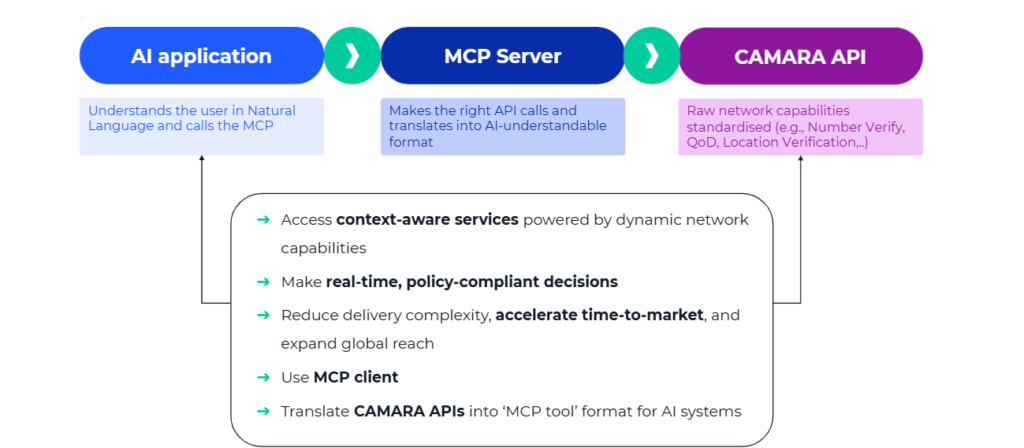
However, network APIs were originally designed for applications rather than autonomous AI agents. For agents to use these capabilities effectively, they must understand what each does, when to apply it, and how to invoke it independently. This is where the Model Context Protocol (MCP) becomes essential.
MCP serves as a critical architectural layer that bridges network APIs and AI applications, translating standardized telecom capabilities into a format that agents can understand and use autonomously.
It converts standardized network APIs into AI-readable structured tools. This allows agents to understand and act on telecom capabilities without custom operator-level integration.
How does this help enterprises?
- Smarter and context-aware decision-making: AI agents leverage capabilities such as Quality on Demand, Edge Discovery, and Device Location as live decision inputs to optimize bandwidth, verify identification, and compute placement.
- Compliant autonomous actions: MCP facilitates AI systems with a common interoperability layer. It promotes consent-driven, privacy-aware decisions that are compliant across various operator environments.
- Deploying rapidly at a global scale: Standardizing CAMARA eliminates the requirement for operator-specific integration logic. It helps teams reduce complexity, accelerate time-to-market, and expand across markets more quickly.
At Proximus Global, we are exploring MCP integration directly to our Konera platform to unlock that network API potential.
Use cases: agentic AI with network APIs
When you converge the capabilities of agentic AI with network APIs, the real-life applications you get are extensive and will continue to expand over time.
- Banks and financial services
Today, fraud detection is largely reactive. By the time a suspicious transaction is flagged, the window for damage has already opened. Agentic AI changes that dynamic. AI agents can continuously monitor transactions. They can make autonomous decisions based on any potential anomaly that happens.
Based on a trigger, it can cross-reference location data with transaction origins, spot impossible travel patterns, and more, all in real time.
If the signals confirm fraud, the agent can block the activity on its own without human intervention. This shuts off the transaction window before it can be exploited.
- Telecommunication
Operators are sitting on some of the most actionable real-time data in any industry. They can run agentic AI on their own network to get a significant operational advantage.
An agent can continuously monitor performance metrics, identify potential degradation before it reaches the customer, trigger network-slicing APIs to reroute traffic, and proactively notify affected users.
Customers never get to file a complaint because it’s resolved before it becomes a problem. This translates directly into lower churn rate, reduced operational cost and improved Net Promoter Scores.
- Manufacturing
In manufacturing environments, the cost of unplanned downtime is rarely just the repair but the cascade of delays, missed commitments, and emergency logistics that follow.
AI agents connected to network APIs such as QoS can track and coordinate with logistics, highlight potential maintenance needs before a breakdown, and manage supplier communication based on live production data.
As these API capabilities expand, the vision is a factory floor that doesn’t just report problems but anticipates and resolves them autonomously.
- Healthcare
In healthcare, the margin for error is narrow, and the consequences of latency are serious. When the Network APIs are paired with agentic AI, they address both.
Device verification APIs can verify the quality of medical equipment before connecting it to clinical systems. QoS APIs can prioritize telemedicine sessions during peak hours to ensure the utmost call quality for remote patient care.
Location APIs can improve emergency response routing. Throughout, AI agents can closely monitor patient data, detect anomalies, and escalate them to clinical staff without delay. This helps the industry achieve better patient safety, greater compliance, and more efficient operational workflows.
- Retail and ecommerce
Right when an account is created, network-level number verification can authenticate a user silently, without adding steps to the onboarding flow.
The device intelligence utilizes the risk score in real-time to flag any potential issues. Legitimate customers experience nothing while high-risk signals are flagged immediately.
What ROI can enterprises expect?
The ROI and overall strategic advantage for agentic AI powered by network APIs can be measured across four dimensions:
- Reducing costs: Businesses get to reduce the need for human intervention for their manual workloads, lowering operational overhead significantly. This also comes from the security improvement, which reduces fraud loss as well.
- Growing revenue: Network APIs and agentic AI can accelerate secure and compliant onboarding, improving customer conversion and trust. As these capabilities compound, so does the commercial impact.
- Mitigating risk: Agents that identify anomalies, enforce compliance controls, and respond to threats in real time can materially reduce enterprise exposure before incidents escalate into significant losses.
- Competitive advantage: Because agentic AI is continuous, it initiates tasks without human intervention and makes decisions in milliseconds. All this at scale with the ability to learn and evolve over time. This gives businesses a considerable competitive advantage.
Addressing executive concerns around agentic AI deployment
Deploying agentic AI raises legitimate questions and concerns that must be addressed in order to move forward.
- Security and privacy: Standardized network APIs built on the CAMARA and GSMA Open Gateway frameworks are designed to meet telco-grade security standards. GDPR, CCPA and data sovereignty requirements are embedded at the core. So, autonomous doesn’t mean unaccountable. Every action an agent takes through a standardized API can be logged, audited, and traced.
- Complexity of integration: One of the core premises of API aggregation platforms like Konera is to simplify integration complexity and reduce the integration burden. Instead of negotiating and integrating with operators on a market-by-market basis, enterprises can gain multi-operator coverage through a single standardized API layer, creating a stronger foundation for an effective agentic AI architecture.
- Cost and ROI uncertainty: This is a genuine concern, and the answer isn’t to overpromise. A pilot-first approach, with defined success metrics, consumption-based pricing, and clear payback expectations, reduces financial exposure during early-stage adoption and lets you build internal confidence before scaling.
- Organizational change management: Enterprises need to make sure they have executive sponsorship. For successful deployment, it has to be more than technical integration. There has to be clear ownership across technology and operations teams.
Why act now?
The conditions for agentic AI adoption are converging, and the window for early movers is open.
On the network side, coverage and standardization have reached a meaningful scale. The GSMA Open Gateway and CAMARA frameworks have already made meaningful progress in improving API consistency across operators and markets. While commercial network APIs are not yet available everywhere or delivered with complete uniformity, the underlying foundation is strong and continues to expand.
On the AI side, the transition from assistive tools to autonomous agents is already well underway. Enterprises across telecom, finance, healthcare, and other sectors are increasingly evaluating agentic architectures not as a long-term innovation bet, but as a near-term operational priority. The strategic intent is clear, and the supporting infrastructure is beginning to mature in parallel.
For enterprises, the strategic case for moving early is straightforward: those who build familiarity with agentic workflows now, through pilots, standards-aligned integrations, and defined use cases, will be better positioned as API coverage matures and agent capabilities expand.
At Proximus Global, we are actively building the bridge between network APIs and agentic AI through an MCP-based integration layer within the Konera platform. We see this as a meaningful pathway for enterprise value creation as standards and interoperability continue to evolve. While the work is still progressing, our focus remains on bringing this capability to market as the technology ecosystem matures.
What should enterprise leaders prioritize next?
Turning agentic AI and network APIs into measurable business outcomes requires clear ownership across leadership functions. Agentic AI doesn’t get operationalized by technology teams alone. It requires alignment across the leadership to move from pilot to scale.
- CEOs and board members: They should focus on a strategic imperative. The core question isn’t whether to invest in agentic AI, but where it accelerates the company’s existing priorities. The budget allocation and executive sponsorship should be done accordingly.
- CTOs and technology leaders: They need to assess where the architecture is already mature and where capability gaps still remain. Which workflows are suitable for autonomous execution? Where can network intelligence strengthen real-time decision-making? The right starting point is a pilot environment that helps answer these questions before moving toward broader integration.
- Chief digital officers: These functions need to identify where customer journeys, onboarding flows, or service operations can benefit most from real-time network intelligence. They also prioritize high-impact use cases that should align with cross-functional stakeholders.
- CFOs and finance leaders: They create practical business cases tied to concrete outcomes – fraud reduction, operational efficiency, customer conversion, service reliability. They are also responsible for defining ROI models early, allocating investment for proofs of concept, and establishing measurement frameworks that support phased scaling decisions.
- CISOs and security leaders: They should be involved from the start, not brought in at the end. While network APIs can strengthen identity assurance, fraud prevention, consent handling, and privacy controls, their focus should be on defining governance standards, risk frameworks, and compliance requirements before autonomous workflows move into production.
Conclusion
The convergence of agentic AI and network APIs is no longer a distant possibility. It is an enterprise direction already taking shape across industries.
As the network API ecosystem continues to mature, the enterprises now have growing access to capabilities such as local intelligence, identity assurance, and real-time service controls. The companies that begin building operational familiarity today will be better positioned to scale with confidence as these capabilities expand.
This shift is not about replacing human judgment. It is rather about removing the bottlenecks that slow it down, giving organizations the ability to sense, decide, and act at a speed and scale that manual processes simply can’t match.
What once existed as fragmented automation is now evolving into orchestrated, closed-loop workflows that are far more adaptive and resilient. The differentiator between early leaders and late adopters will not be access to the technology itself, but the willingness to operationalize it before every variable is fully settled.
At Proximus Global, we work on connecting network APIs with emerging agentic AI architectures that continue to evolve alongside the broader standard ecosystem. As the technology matures, our focus remains on helping companies translate this convergence into practical and scalable transformation.
The infrastructure is already there, but the only question is whether the organizations are ready to build on it.
 Share
Share
 Share
Share